
PERSONALITY · DARK TRIAD
Dark Triad Test: your three trait scores
Our free dark triad test scores the three everyday traits of dark triad research, narcissism, Machiavellianism and psychopathy, on a 0–100 scale, with the useful and costly side of each. 27 statements, about 5 minutes. Not a diagnosis.
- 28 questions
- About 5 minutes
- Free summary
- Full report optional
Sample result
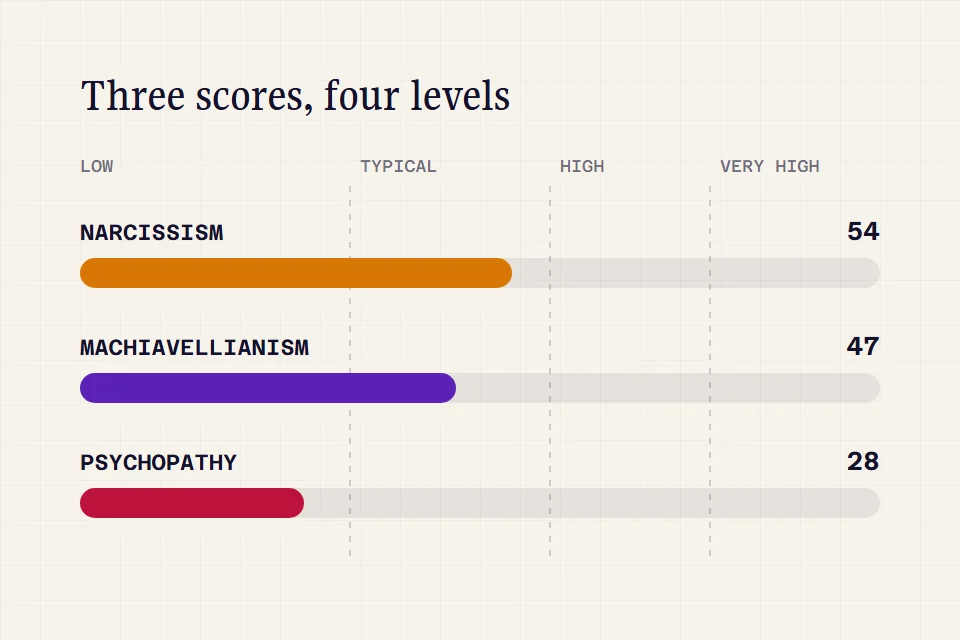
Typical range · highest: Narcissism
Example only. Yours comes with your own three scores.
Built by the Insight Metrics team
- Written by Alden Cross, Research Writer
- Research check by Leon Falkner, Data & Research Analyst
- Reviewed by Aarav Vardhan, Editor-in-Chief
Insight Metrics is trusted by 2.4M+ people · As seen in Forbes and Wired
- Questions
- 27 statements + 1 optional pick
- Time
- About 5 min
- Cost
- Free to take · free summary
- Full report
- Optional
- Based on
- The structure of the Short Dark Triad
INTRODUCTION
The Dark Triad Test is a free dark triad personality test that shows how much of each of the three dark triad traits your answers describe: narcissism, Machiavellianism and psychopathy. You rate 27 short statements, 9 per trait, written by our team. You get three scores from 0 to 100, a level for each and the useful and costly side of every trait. These are everyday traits everyone has to some degree, and the result is never a diagnosis.
3
trait scores, each from 0 to 100, never one “darkness” number
27
statements written by our team, 9 for each trait
4
levels per trait: low, typical, high and very high
I like being the centre of attention.
How much do you agree?
Pick an answer to start. Your choice is saved and the test continues from question 2.
HOW IT WORKS
How the dark triad test works
- 01
Answer 28 short questions
Rate 27 statements like “I enjoy taking risks that make other people nervous” from Strongly disagree to Strongly agree. Answer honestly; nobody else sees your answers. Then, if you like, say what brought you to the test.
- 02
See your free summary
A short form asks for your contact details, then your result opens: your three trait scores and levels, the useful side of your profile and a note on how to read it.
- 03
Go deeper if you want
The full report is optional. It covers your profile with people, at work and under pressure, each trait at your level, relationships, work and a 4-week plan, on the page and as a PDF.
See your three trait scores
Take the dark triad quiz free: 28 short questions, about 5 minutes, with all three scores and their levels in a free summary.
Free to take · Free summary · Full report optional
THE 3 TRAITS
The three traits the test scores
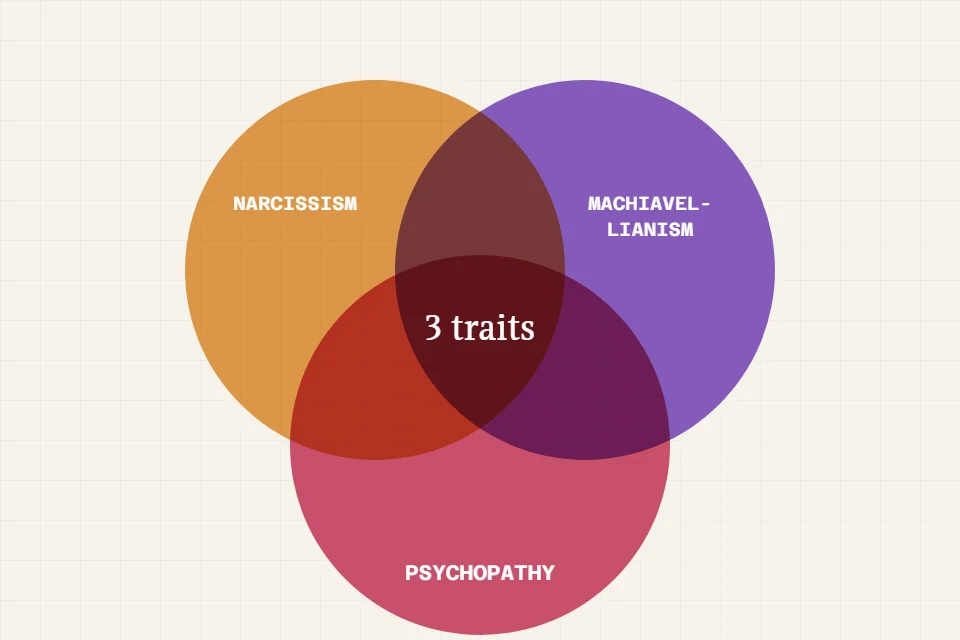
Each trait is a scale, not a label. Everyone sits somewhere on all three, and the three overlap: when one is higher, the others often are too.
Narcissism
Self-focus, confidence and a need for admiration: enjoying attention, feeling special, expecting recognition. Its useful side is presence and leadership.
Read about narcissism scoresMachiavellianism
A strategic, calculating approach to people: planning ahead, keeping information close, seeing others as means to an end. Its useful side is planning and negotiation.
Read about Machiavellianism scoresPsychopathy
Everyday impulsivity, thrill-seeking, bluntness and low guilt, not the clinical condition. Its useful side is calm and boldness under pressure.
Read about psychopathy scoresFeatures
What a result looks like
A made-up example. None of this person’s scores is high, so the result is the typical range. Narcissism is highest: healthy confidence and enjoying recognition, without needing constant admiration.
WHAT YOU GET
Free summary, optional full report
Free summary
- Your three trait scores from 0 to 100
- Your level on each trait
- The useful side of your profile
- A short note on what each score means
- A note based on why you took the test
Full report
- Your profile with people, at work and under pressure
- Each trait at your level: useful side, costly side, one tip
- Your traits in close relationships
- Your traits at work
- A 4-week plan, plus a PDF copy
The test and summary are free. The full report is optional, with a full refund if you ask within 3 days.
Why this dark triad test is different
Most dark triad quizzes give you a “darkness” percentage. Ours gives three separate scores, the useful side of each trait and a plain reminder of what a self-report test can and can’t tell you.
- No darkness %
- Useful and costly sides
- Light triad context
- Published cut-offs
- Not a diagnosis
- Kind, plain wording
- For self-reflection
QUICK ANSWERS
Dark triad test: quick answers
Short, direct answers to the questions people ask most, written and checked by our editorial team.
What does a dark triad test measure?
A dark triad test measures three overlapping personality traits: narcissism (self-focus and a need for admiration), Machiavellianism (strategic, calculating dealings with people) and psychopathy (impulsivity, thrill-seeking and low empathy). In research these are everyday, or subclinical, levels in ordinary people. A test gives a score for each trait, not a diagnosis of any personality disorder.
How is the dark triad test scored?
Our test has 9 statements per trait, answered from Strongly disagree to Strongly agree. Each trait score is your average answer, turned into a 0–100 scale: low is under 35, typical 35–60, high 60–80 and very high above 80. Two statements per trait are worded the other way round, so agreeing with everything doesn’t push you up.
What does a high dark triad score mean?
A high score means your answers describe more of that trait than most people show: more self-focus for narcissism, more strategy for Machiavellianism or more impulsiveness for psychopathy. It is not a diagnosis and doesn’t make someone a bad person. It points to habits that can cost trust, and those habits can change with practice.
Is a dark triad test accurate?
Research scales such as the 27-item Short Dark Triad measure the traits reasonably well in groups, but every self-report test has limits. People can answer in a flattering way, and the three traits overlap a lot. Very short versions, such as the 12-item Dirty Dozen, have been criticised for measuring psychopathy too thinly. Treat any single result as a starting point.
Can you have all three dark triad traits?
Yes. Everyone has some of all three, and because the traits overlap, people who score high on one often score higher on the others too. Research ties much of what they share to low agreeableness and low honesty-humility. Our result says so plainly when two or more traits are high, and the full report focuses on that shared core.
Is the dark triad the same as a personality disorder?
No. Dark triad research measures everyday levels of traits in ordinary people. Narcissistic personality disorder and antisocial personality disorder are clinical diagnoses made by a qualified professional after a full assessment, and Machiavellianism is not a diagnosis at all. A high score on an online test cannot tell you whether anyone has a disorder.
Can I use this test on someone else?
No. A dark triad test only describes the person who answers it. Answering on someone else’s behalf gives your guess about them, not their result, and labelling a partner, boss or relative from a quiz can do real harm. If you are worried about someone’s behaviour, look at what they actually do, and talk to someone you trust.
What is the light triad?
The light triad is a set of three traits proposed by Scott Barry Kaufman and colleagues in 2019: Kantianism (treating people as ends, not means), humanism (valuing everyone’s dignity) and faith in humanity (believing people are basically good). It is related to the dark triad but not its opposite, and the average person scores higher on light traits than dark ones.
What is the dark tetrad?
The dark tetrad adds a fourth trait to the dark triad: everyday sadism, the enjoyment of other people’s pain. Researchers including Delroy Paulhus have built short scales that measure all four traits. Our test measures the original three, because they have the most research behind them; the dark triad article explains the tetrad in more detail.
Do men score higher on the dark triad?
On average, yes. Men score somewhat higher than women on all three traits, with the biggest gap on psychopathy and the smallest on narcissism. These are group averages with large overlap: many women score higher than many men. Sex differences tell you nothing about any single person’s result.
How is the dark triad linked to the Big Five?
All three dark triad traits go with low agreeableness. Machiavellianism and psychopathy also go with low conscientiousness, and narcissism with higher extraversion. In the HEXACO model, low honesty-humility is the strongest single link. The Big Five together explain most of the variation in psychopathy scores and less of the variation in narcissism.
How long does the dark triad test take?
About 5 minutes. There are 27 statements, 9 for each trait, answered on a five-point scale from Strongly disagree to Strongly agree, plus one optional question about what brought you to the test. Your free summary, with your three scores and levels, opens right after a short form.
What is the dark triad test?
In short
The dark triad test is a short self-report questionnaire that scores narcissism, Machiavellianism and psychopathy separately. Ours uses 27 of our own statements, 9 per trait, and shows each score with its level and its useful and costly side.
| Trait | Higher scores look like | Useful side | Costly side |
|---|---|---|---|
| Narcissism | Enjoying attention, expecting recognition | Confidence, presence | Others feel overlooked |
| Machiavellianism | Planning ahead, keeping information close | Strategy, negotiation | Trust drops |
| Psychopathy | Risk-taking, bluntness, low guilt | Calm in a crisis | Impulsive harm |
For what the dark triad is, where the idea came from and the signs in everyday life, read what the dark triad is.
How the dark triad test is scored
In short
Each trait score is your average on its 9 statements, on a 0–100 scale. Low is under 35, typical 35–60, high 60–80 and very high above 80. If none is high, your result is the typical range; if two or more are high, it says so.
Two of each trait’s statements are worded the other way round, like “I feel bad for a long time if I hurt someone’s feelings”, so the test can’t be answered on autopilot. If most of your answers were Neutral or the same, your result notes it and suggests a retake. The cut-offs are our own and this is a new test, so the scores are not percentiles. What each level means is explained in dark triad test results explained.
Where the questions come from
In short
Our statements follow the published structure of the Short Dark Triad (Jones and Paulhus, 2014), the most used research scale, with 9 statements per trait. We wrote every statement ourselves; no item is copied from the Short Dark Triad or the Dirty Dozen.
Unlike a general personality test, dark triad scales focus on three traits only. The Short Dark Triad covers reputation and strategy for Machiavellianism, leadership and exhibitionism for narcissism, and impulsivity and callousness for psychopathy. The shorter 12-item Dirty Dozen (Jonason and Webster, 2010) is popular online, but researchers found its psychopathy part too thin (Miller and colleagues, 2012). That is why our test uses 9 statements per trait rather than 4.
Everyday traits, not a diagnosis
In short
Dark triad research measures everyday levels of three traits in ordinary people. A high score is not narcissistic personality disorder, antisocial personality disorder or psychopathy as a clinical condition; those are assessed by qualified professionals in person.
The word “psychopathy” in this research describes impulsivity and low empathy on a scale, not a dangerous person. If you want to understand the clinical side, read what a sociopath is, which covers antisocial personality disorder, its real signs and how to stay safe. If you took the test because you are worried about someone else, remember that it can only describe the person answering it.
What research says about the three traits
In short
The three traits overlap heavily and share a core of low agreeableness and low honesty-humility (Muris and colleagues, 2017). At work, Machiavellianism and psychopathy go with more counterproductive behaviour, while none of the three does much for job performance (O’Boyle and colleagues, 2012).
- Overlap: people high on one trait are often higher on the others, and some researchers describe a single dark core behind them (Moshagen, Hilbig and Zettler, 2018).
- Sex differences: men score higher on average, most of all on psychopathy and least on narcissism; for narcissism, a meta-analysis found the gap mostly in entitlement and leadership (Grijalva and colleagues, 2015).
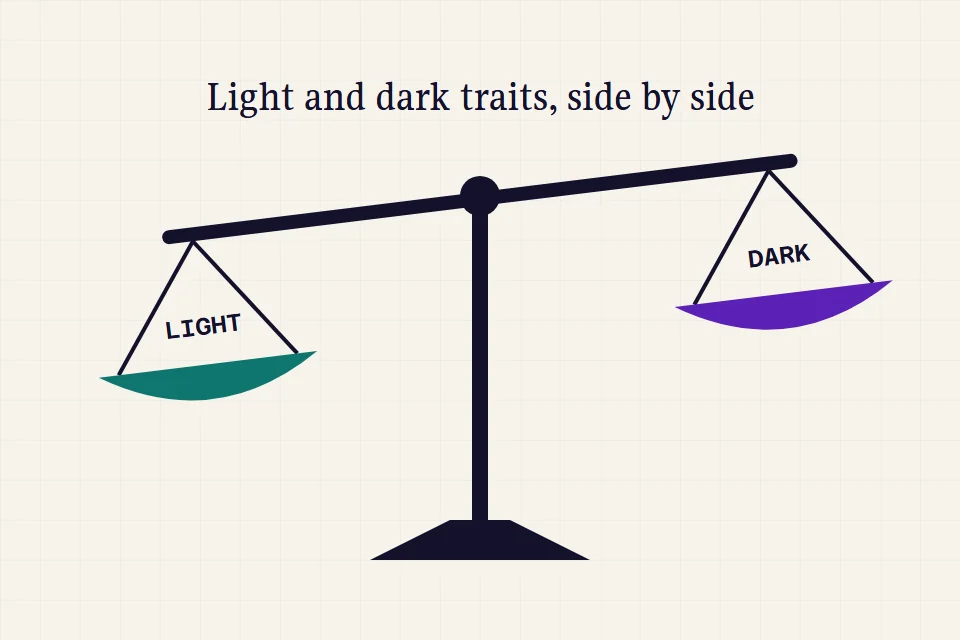
- The light side: a light triad of humanism, Kantianism and faith in humanity is related but not opposite, and most people score higher on light traits (Kaufman and colleagues, 2019).
- Change: traits shift slowly with age and practice; the habits behind high scores, like acting on impulse, can be learned differently.
The dark triad, the Big Five and the 16 types
In short
All three traits go with low agreeableness; narcissism also goes with higher extraversion. There is no good evidence that any of the 16 personality types is narcissistic or psychopathic, and every type can be kind or unkind.
Small links run through the Big Five: a Thinking preference sits a little closer to lower agreeableness, and Extraversion to narcissism, but these are averages, not rules. For trait scores that include agreeableness, take the free Big Five personality test. To see your four letters, take the personality test. For empathy and self-control as skills, try the emotional intelligence test.
Read the full guide to your scores
In short
Each trait has its own page about what low, typical and high scores mean, the useful and costly sides and how to change the habits behind a high score.
FAQ
Dark Triad Test FAQ
Is this dark triad test free?
Yes. It is free to take, with a free summary that shows your three trait scores, your level on each and the useful side of your profile. A full report is optional.
How many questions are in the test?
28: 27 statements, 9 for each trait, plus one optional question about what brought you to the test. It takes about 5 minutes.
Is this the Short Dark Triad (SD3)?
No, this is not the Short Dark Triad (SD3) test itself. We follow the SD3’s structure of 9 statements per trait, but every statement is our own wording. For research, use the published scale and its norms.
Am I a bad person if I score high?
No. These are everyday traits everyone has to some degree. A high score points to habits that can cost trust, and habits can change. The fact that you are checking is itself a good sign.
Can this test tell me if I am a narcissist or a psychopath?
No. It measures everyday trait levels, not personality disorders. Only a qualified professional can assess narcissistic or antisocial personality disorder, in person.
Can I take it for my partner or boss?
No. It only describes the person who answers it. Your guesses about someone else are not their result. If you feel unsafe, talk to someone you trust or a helpline.
Why don’t you give one dark triad percentage?
Because the three traits have different useful and costly sides. One number would hide whether you are mostly confident, mostly strategic or mostly impulsive.
Can my scores change?
Yes. Traits shift slowly with age and experience, and the habits behind high scores, like acting on impulse or holding information back, respond to practice.
Is there a light/dark triad test?
Your result includes a short reading of the light side next to your three dark scores, so it works as a simple light dark triad test. A full light triad scale is not part of this test.
Is a low score always good?
Mostly, but very low scores can mean underselling yourself or being too trusting. The full report covers the costly side of low scores too.
What is a typical score?
On our scale, 35 to 60 is typical. In published samples, most people score near the middle on Machiavellianism and below it on psychopathy.
Is my data private?
Your answers are used to score your result. We don’t sell your details. See our Privacy Policy for how long results are kept and how to ask for them to be deleted.
Who wrote this test?
The Insight Metrics editorial team: written by Alden Cross, research-checked by Leon Falkner and reviewed by Aarav Vardhan. The statements are our own wording.
START YOUR ASSESSMENT
See your three dark triad scores
A free dark triad personality quiz: 28 questions, about 5 minutes. Free to take, free summary, full report only if you want it.