

PERSONALITY · TYPE A AND TYPE B
Type A Personality Test: am I Type A or Type B?
Our free Type A personality test places you on the scale from Type B to Type A and scores the four parts researchers measure: pace, drive, irritability and switching off. 28 short statements, about 5 minutes, written by our own team.
- 29 questions
- About 5 minutes
- Free summary
- Full report optional
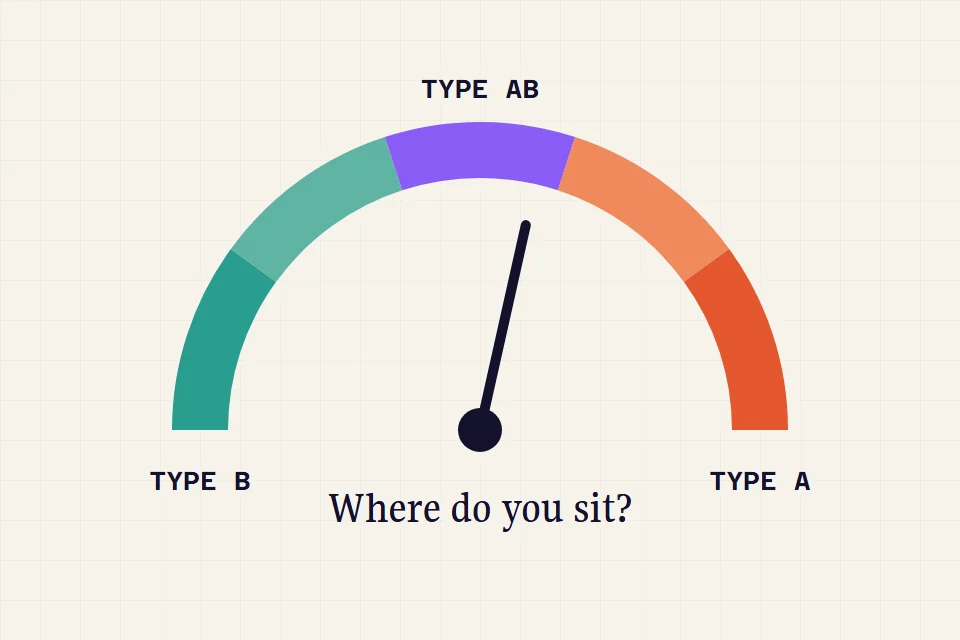
Sample result
Type A · A-leaning (68)
Example only. Yours comes with your own four scores.
Built by the Insight Metrics team
- Written by Alden Cross, Research Writer
- Research check by Leon Falkner, Data & Research Analyst
- Reviewed by Aarav Vardhan, Editor-in-Chief
Insight Metrics is trusted by 2.4M+ people · As seen in Forbes and Wired
- Questions
- 28 statements + 1 quick pick
- Time
- About 5 min
- Cost
- Free to take · free summary
- Full report
- Optional
- Based on
- The four parts of the Type A research
INTRODUCTION
The Type A Personality Test is a free Type A Type B personality test that shows how much of the classic Type A pattern you carry. You rate 28 short statements about hurry, goals, irritation and rest. Instead of one label, you get a Type A score from 0 to 100, a band from strong Type B to strong Type A, and four part scores, because research shows that being driven and being irritable are very different things.
4
parts scored separately: pace, drive, irritability and switching off
28
statements written by our team, 7 for each part
5
bands from strong Type B through Type AB to strong Type A
I get restless when I have to wait in a queue, even for a few minutes.
How much do you agree?
Pick an answer to start. Your choice is saved and the test continues from question 2.
HOW IT WORKS
How the Type A test works
- 01
Answer 29 short questions
Rate 28 statements like “I get restless when I have to wait in a queue” from Strongly disagree to Strongly agree. Answer for an ordinary week. Then, if you like, pick the description that sounds most like you.
- 02
See your free summary
A short form asks for your contact details, then your result opens: your Type A score and band, your four part scores, three strengths and how your own view compares with your answers.
- 03
Go deeper if you want
The full report is optional. It covers your pattern at work and at home, each part at your level, your pressure points, careers, you with Type A and Type B people, and a 4-week plan, on the page and as a PDF.
Find out how Type A you really are
Take this Type A vs Type B personality test free: 29 short questions, about 5 minutes, with your score, your band and all four parts in a free summary.
Free to take · Free summary · Full report optional
TYPE A, TYPE AB, TYPE B
The three results on the Type A scale
Type A and Type B are the two ends of one scale, not two boxes. Most people land in between, in the Type AB band. Where you sit, and which parts push you there, matters more than the name. This Type A or Type B personality test shows both.
Type A
Score 61–100. Fast, goal-focused and competitive, with a strong sense of time. Type A people get a lot done; the costs show up when impatience turns into irritation or rest stops happening.
Read the Type A personality guideType AB
Score 41–60. A mix of both: driven when it counts, relaxed when it doesn’t. Friedman and Rosenman used the AB label for people who showed both patterns. It has nothing to do with blood type AB.
Read the Type AB personality guideType B
Score 0–40. Easygoing, patient and hard to rush. Type B is not the same as lazy: Type B people can be just as capable, they simply feel less time pressure and less need to win.
Read the Type B personality guideFeatures
What a result looks like
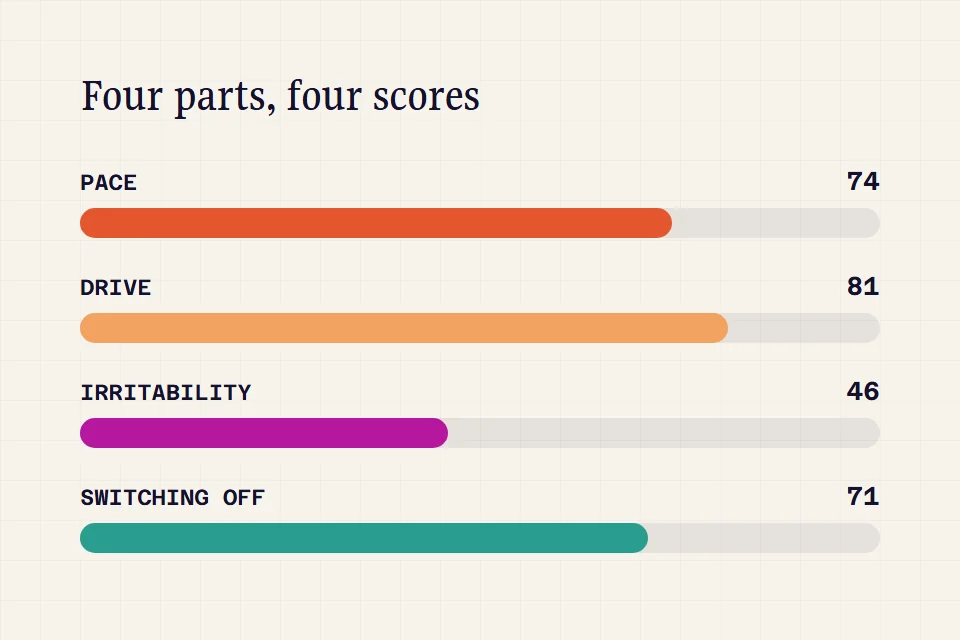
A made-up example from the Type A vs Type B quiz. This person scores 68, in the A-leaning band. Drive and pace are high, but irritability is in the middle, the pattern research links to achievement more than to stress.
WHAT YOU GET
Free summary, optional full report
Free summary
- Your Type A score from 0 to 100
- Your band, from strong Type B to strong Type A
- Your four part scores: pace, drive, irritability, switching off
- Three strengths of your pattern
- Your own view compared with your answers
Full report
- Your pattern at work, at home and under pressure
- All four parts explained at your level
- Your pressure points and ways to recover
- Work style and career directions
- You with Type A, AB and B people
- A 4-week plan, plus a PDF copy
The Type A Type B quiz and summary are free. The full report is optional, with a full refund if you ask within 3 days.
Why this Type A test is different
Most Type A personality vs Type B quizzes give you one label. Ours gives you the four parts the research separates, a published scoring rule and a plain answer when you sit in the middle.
- Published cut-offs
- Type AB band
- Our own questions
- Drive vs irritability
- Work and careers
- No heart-risk claims
- For self-reflection
QUICK ANSWERS
Type A personality test: quick answers
Short, direct answers to the questions people ask most, written and checked by our editorial team.
What is a Type A personality?
A Type A personality is a pattern of behaviour marked by time urgency, competitiveness, high drive and, in some people, impatience and hostility. Cardiologists Meyer Friedman and Ray Rosenman described it in 1959. Today researchers treat it as a scale rather than a type: everyone has some Type A habits, and most people sit somewhere between the Type A and Type B ends.
What is a Type B personality?
A Type B personality is the opposite end of the same scale: relaxed, patient, unhurried and not very competitive. Type B people feel less time pressure and are slower to anger, but that does not make them lazy or less able. In Friedman and Rosenman’s original studies, Type B simply meant the absence of the Type A pattern.
How do I know if I am Type A or Type B?
Look at four habits: whether you feel rushed most days, whether you set goals and want to win, whether delays and slow people irritate you, and whether you can switch off from work. If most of these fit strongly, you lean Type A. If few fit, you lean Type B. A test scores each habit separately and adds them up.
What is a Type AB personality?
Type AB describes people who show a mix of Type A and Type B habits, driven in some situations and relaxed in others. Friedman and Rosenman used the label for people who did not fit clearly at either end. On our test, Type AB is a score of 41 to 60. It has nothing to do with blood type AB personality ideas.
What are the four parts of Type A?
Research splits Type A into time urgency (hurry and impatience with waiting), drive and competitiveness (achievement striving), irritability or hostility (getting annoyed or angry, especially under pressure) and work involvement (finding it hard to switch off). The Jenkins Activity Survey measured versions of these, and later studies showed the parts relate to health and success in different ways.
Is a Type A personality bad for your heart?
The early studies said yes, but the overall Type A pattern did not hold up in later research. A 22-year follow-up found no link with heart deaths, and reviews of prospective studies found no reliable effect. Of all the parts, long-term anger and hostility have the best evidence, and even that effect is modest. A personality test is not a health check.
Is Type A better than Type B?
Neither is better. Type A drive goes with getting things done and, in students, with better grades. Type B calm goes with patience and less stress. The research points to one part as costly, irritability and hostility, and one as useful, achievement striving. A healthy mix keeps the drive and lets go of the anger.
Can you change from Type A to Type B?
Habits can shift, even if your basic temperament stays similar. In a large trial with heart-attack survivors, counselling that targeted Type A habits reduced those habits and repeat heart problems compared with usual care. On an everyday level, buffers, slower routines, anger pauses and real time off can all move your scores toward the middle.
What are Type C and Type D personalities?
Type C was a 1980s idea of a calm, people-pleasing person who holds emotions in; the evidence for its cancer link is weak. Type D means distressed: high worry and low mood together with holding back in social situations. It is measured with the DS14 scale. Neither is simply more or less Type A, and our test measures only the A to B scale.
How long does the Type A test take?
Our Type A personality test takes about 5 minutes. It has 28 statements, 7 for each of the four parts, plus one optional question where you pick the description that sounds like you. You answer each statement on a five-point scale from Strongly disagree to Strongly agree, and your free summary opens right after a short form.
Which careers suit Type A and Type B people?
Type A people often enjoy roles with clear targets and fast decisions, such as project management, sales or emergency work. Type B people often thrive where care and patience matter, such as counselling, research or design. Either type can succeed anywhere; what matters is a pace you can sustain. An interest-based career test gives more specific job matches.
Is Type A a personality disorder?
No. Type A is a pattern of everyday behaviour, not a mental health diagnosis, and it does not appear in the DSM or ICD. Many Type A people are healthy, happy and successful. If constant pressure or anger is affecting your sleep, health or relationships, that is worth talking about with a doctor or counsellor, whatever your score.
What is a Type A personality test?
In short
A Type A personality test is a short self-report questionnaire that measures how much of the Type A behaviour pattern you show. Ours scores four parts separately (pace, drive, irritability and switching off) and combines them into one Type A score from 0 to 100.
| Part | What it describes | Higher scores look like |
|---|---|---|
| Time urgency | Feeling short of time | Hurrying, multitasking, hating queues |
| Drive and competitiveness | Achievement striving | Goals for everything, playing to win |
| Irritability | Impatience turning into anger | Snapping under pressure, holding grudges |
| Work involvement | How much work fills your life | Working late, guilt about rest |
We show the four parts because a single label hides the most useful information. Two people can both score 70: one through goals and drive, the other through irritation and hurry. Their days, and what would help them, look very different. For the full picture of each result, read the Type A personality guide or the Type B personality guide.
How is the Type A test scored?
In short
Each part score is your average answer on its 7 statements, turned into a 0–100 scale. Your Type A score is the average of the four parts. The bands are our own convention: 0–20 strong Type B, 21–40 B-leaning, 41–60 Type AB, 61–80 A-leaning and 81–100 strong Type A.
Two of each part’s seven statements are worded the other way round, like “Running a few minutes late doesn’t bother me much”, so agreeing with everything doesn’t push you to one end. If most of your answers are Neutral, or the same answer many times in a row, your result says so and suggests a retake instead of giving you a label that doesn’t fit.
This is a new test, so the cut-offs are not norms from a large sample and your scores are not percentiles. We publish exactly how the score is built, which most Type A quizzes do not. Read more about our approach in how our tests work.
Type A vs Type B: what is the difference?
In short
Type A and Type B are the two ends of one scale. Type A people feel rushed, set goals for most things and can get irritated by delays. Type B people are relaxed, patient and less competitive. Most people are a mix, which is why the test gives a score rather than a verdict.
| Type A end | Type B end | |
|---|---|---|
| Time | Always short of it | Rarely rushed |
| Goals | Sets goals for almost everything | Does many things just for fun |
| Waiting | Restless and irritated | Patient |
| Rest | Feels guilty | Enjoys it |
| Under pressure | Speeds up, may snap | Stays calm, may slow down |
Sites that offer personality types Type A, B, C, D tests usually mix four unrelated ideas. If you were looking for a Type A, B, C, D personality test free of guesswork, start here for A and B, then read Type A vs Type B personality for a full side-by-side that includes Type C, Type D and Type AB.
Where does the Type A idea come from?
In short
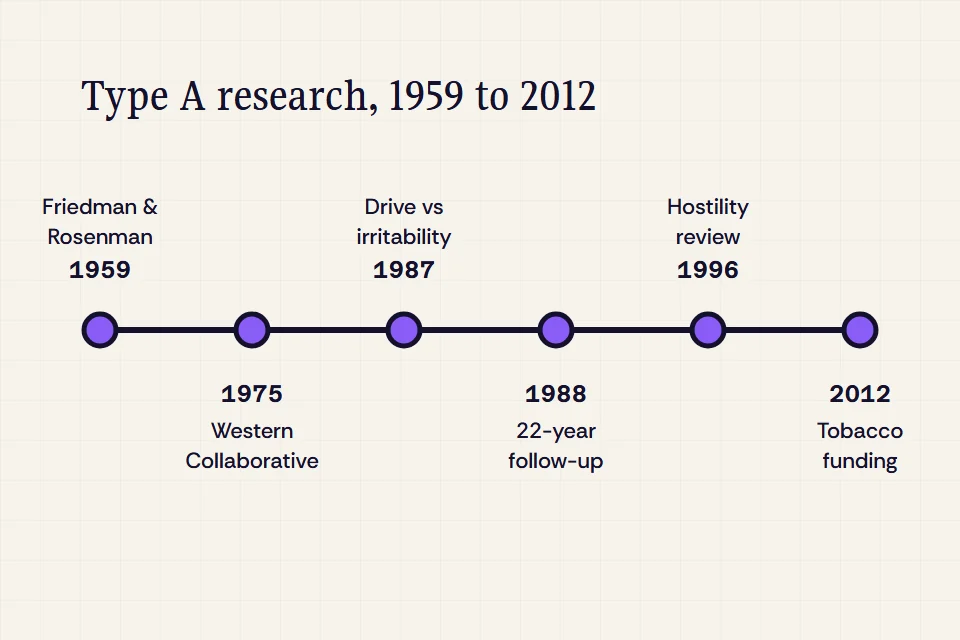
Cardiologists Meyer Friedman and Ray Rosenman described the Type A pattern in 1959, after noticing hurried, competitive behaviour in their heart patients. The Western Collaborative Group Study then followed about 3,000 men and reported roughly twice the heart risk for Type A men after 8.5 years.
That finding made “Type A” a household phrase. Questionnaires such as the Jenkins Activity Survey (1971), the Framingham Type A Scale (1978) and the Bortner scale (1969) were built to measure it. What happened next is the part most quizzes leave out:
- 1988: a 22-year follow-up of the same men found no link between Type A and death from heart disease (Ragland and Brand).
- 1987–2001: reviews found that the hurry and ambition parts did not predict heart disease, while anger and hostility did, modestly (Booth-Kewley and Friedman; Miller and colleagues; Myrtek).
- 2012: tobacco-industry documents showed that Philip Morris funded a large share of Type A research, partly to turn attention away from smoking (Petticrew, Lee and McKee).
None of this means Type A is meaningless. It means the useful questions are about the parts, which is how our test is built.
Why drive and irritability are scored apart
In short
Research found that the two halves of Type A behave differently. In a study of students, achievement striving predicted better grades, while impatience and irritability predicted more health complaints (Spence, Helmreich and Pred, 1987). Mixing them into one label hides that.
A burnout meta-analysis found something similar: overall Type A was linked to a stronger sense of personal accomplishment, not to more exhaustion (Alarcon, Eschleman and Bowling, 2009). The costs tend to sit in two parts: irritability, and never switching off. If your result shows high drive with low irritability, that is a pattern worth keeping. If irritability is your highest part, it is the most useful one to work on, and it is also the one that changes most with practice.
Related reading: high neuroticism explained, the trait behind much of the stress side of Type A.
Type A, the Big Five and the 16 personality types
In short
Type A is not part of the 16-type model, and no study shows that any one type “is” Type A. The links run through the Big Five: drive goes with conscientiousness and extraversion, and irritability with lower agreeableness and higher neuroticism.
Because the J–P preference tracks conscientiousness and E–I tracks extraversion (McCrae and Costa, 1989), people who prefer J and E tend to score a little higher on drive and pace, on average. That is a tendency, not a rule: an INFP can be strongly Type A at work, and an ESTJ can be calm and patient. To see your four letters, take the free personality test. For trait scores, try the Big Five personality test.
Type A and Type B at work and in careers
In short
Type A habits often help in roles with clear targets, deadlines and visible results. Type B habits often help where care, patience and listening matter. Neither type is more successful overall; what matters is a pace you can keep up and a setting that rewards it.
The full report includes work settings and career directions for your pattern. For job matches based on your interests rather than your pace, take the free Career Test, or browse careers by personality type. If your result is B-leaning and you prefer quiet work, careers for introverts ranks 16 jobs by how much people-time they need.
Read the full guide to your result
In short
Each result has its own guide with traits, strengths, stress, relationships and work: start with your own result, then read the one next to it on the scale.
FAQ
Type A Personality Test FAQ
Is this Type A or B quiz free?
Yes. This Type A or B personality quiz is free to take, with a free summary that shows your Type A score, your band, your four part scores and three strengths. A full report is optional.
How many questions are in the test?
29: 28 statements, 7 for each of the four parts, plus one optional question where you pick the description that sounds like you. It takes about 5 minutes.
Am I Type A if I’m organised and like plans?
Not necessarily. Being organised is closer to the Big Five trait of conscientiousness. Type A adds a feeling of time pressure, a need to win and, for some people, irritability. You can be very organised and still score Type B.
Can I be both Type A and Type B?
Yes. Most people are a mix, which is why our test has a Type AB band for scores of 41 to 60. Many people are Type A at work and Type B at home.
Is this the Jenkins Activity Survey?
No. The Jenkins Activity Survey is a commercial questionnaire from the 1970s that is no longer in print. We wrote our own 28 statements around the same research themes and publish exactly how they are scored.
Does my score tell me my heart risk?
No. This is a personality test, not a health check, and the overall Type A pattern did not hold up as a heart-risk factor. If you have health worries, talk to your doctor.
Why do I get four part scores?
Because the parts behave differently. Drive is linked to achievement, while irritability is the part most linked to stress. Seeing them apart tells you what to keep and what to work on.
Is a Type B personality lazy?
No. Type B describes how much time pressure and competitiveness you feel, not how hard you work or how capable you are. Many Type B people are highly effective.
Can my result change?
Yes. Busy seasons, a new job or deliberate practice can all move your scores. Retaking the test after a few months is a good way to see what has changed.
Is this a Type A, B or C personality test?
It measures the Type A to Type B scale, with Type AB in the middle. Type C and Type D are different ideas, not points on this scale. The Type A vs Type B guide explains Type C and Type D and how they differ.
What does my Type A score mean in numbers?
0 means every answer pointed to the relaxed Type B end and 100 means every answer pointed to the Type A end. 41 to 60 is the balanced Type AB band where most people land.
Is my data private?
Your answers are used to score your result. We don’t sell your details. See our Privacy Policy for how long results are kept and how to ask for them to be deleted.
Who wrote this test?
The Insight Metrics editorial team: written by Alden Cross, research-checked by Leon Falkner and reviewed by Aarav Vardhan. The statements are our own wording, based on the published Type A research.
START YOUR ASSESSMENT
Find out if you are Type A, Type B or in between
A Type A or B personality test, free to take: 29 questions, about 5 minutes. Free to take, free summary, full report only if you want it.