

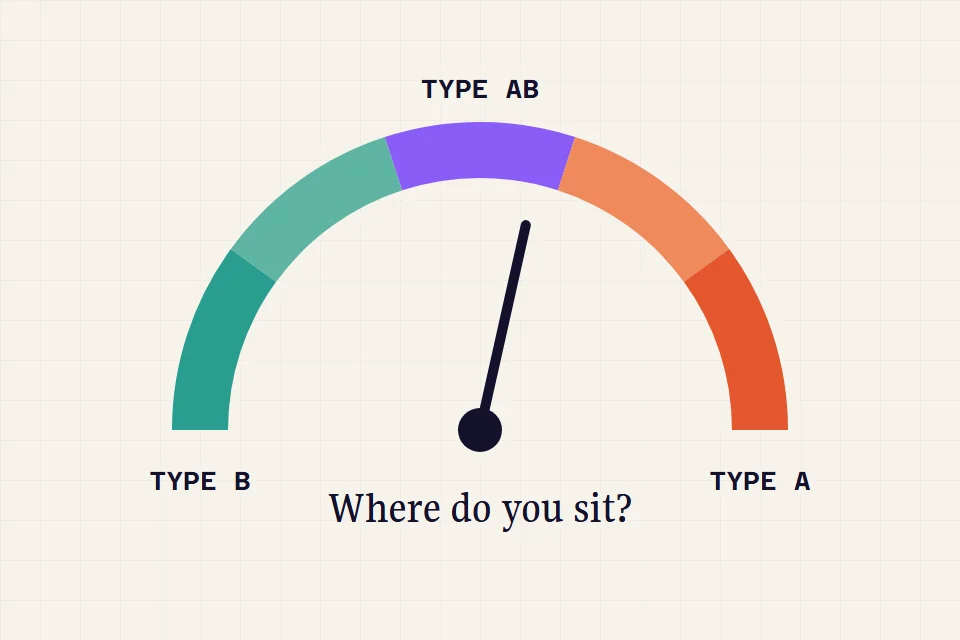
The short answer
A Type A personality is a pattern of behaviour marked by time urgency, competitiveness, high drive and, in some people, impatience and hostility. Cardiologists Meyer Friedman and Ray Rosenman described it in 1959. Today it is treated as a scale, and research shows its parts differ: drive goes with achievement, while long-term hostility is the part linked to stress and health.
On this page
DefinitionWhat Is a Type A Personality?
In shortA Type A personality is a pattern of time urgency, competitiveness, high drive and, in some people, impatience and hostility. Cardiologists Meyer Friedman and Ray Rosenman described it in 1959. Today it is treated as a scale: everyone has some Type A habits.
Friedman and Rosenman noticed the pattern in their heart patients: people who were always in a hurry, set themselves constant goals and were easily irritated by delays. Researchers later split the pattern into four parts, and the parts turned out to behave differently.
| Part | What it covers |
|---|---|
| Time urgency | Feeling rushed, hating waiting, doing several things at once |
| Drive and competitiveness | Setting goals, wanting to win, pushing to be among the best |
| Irritability | Getting annoyed, impatient or snappy, especially under pressure |
| Work involvement | Working late, thinking about tasks on holiday, finding rest hard |
TraitsType A Personality Traits: Strengths and Weaknesses
In shortType A strengths are drive, focus and getting things done. The weaknesses are impatience, irritation under pressure and finding it hard to rest.
Strengths
- You get things done and rarely leave a task half-finished.
- You set clear goals and push yourself to reach them.
- You stay focused under deadlines that freeze other people.
- Others trust you to make things happen.
- You notice wasted time and find faster ways to work.
Weaknesses to watch
- Rest can feel like falling behind, which makes recovery harder.
- Other people’s pace can wind you up more than the task itself.
- When every day is a race, it’s easy to miss what’s going well.
Signs12 Signs of a Type A Personality
In shortThe clearest signs of a Type A personality are feeling short of time, doing several things at once, needing to win, getting irritated by delays and finding it hard to rest without guilt.
Each sign belongs to one of the four parts researchers measure. Two or three signs are normal; Type A means many of them, most days.
- Time urgency: you check the clock often and feel behind even on a quiet day.
- Fast pace: you walk, talk and eat quickly, and finish other people’s sentences.
- Multitasking: you answer emails in meetings or read while you eat.
- Impatience with waiting: queues, slow drivers and loading screens wind you up.
- Competitiveness: you keep score, even in games that do not matter.
- Goals for everything: holidays, hobbies and weekends get targets and lists.
- High standards: you redo other people’s work because it is faster.
- Quick irritation: small mistakes or delays make you snap.
- Work on your mind: you think about tasks at dinner, on holiday and in bed.
- Guilt when resting: a free afternoon feels wasted.
- Taking on more: you say yes to new projects before the old ones are done.
- Hard to switch off: you need a task to feel calm.
ExamplesType A Personality Examples in Everyday Life
In shortType A shows up in small moments: changing lanes to gain a few seconds, turning a weekend run into a timed race, or checking work messages on a beach.
| Situation | Typical Type A reaction | Typical Type B reaction |
|---|---|---|
| Stuck in traffic | Switches lanes, checks the time, feels angry | Puts on music and accepts the delay |
| A board game with friends | Plays to win and keeps score | Plays for the company |
| A free Saturday | Writes a to-do list for it | Lets the day unfold |
| A colleague is slow | Takes the task over | Waits or offers help |
| On holiday | Checks work email every day | Leaves work behind |
Myth checkDoes Type A Mean Organized?
In shortNot in the research sense. In everyday speech “Type A” often means organized and tidy, but the original Type A pattern is about hurry, drive and irritability. Being organized belongs to a different trait, conscientiousness.
Many Type A people are organized because planning helps them move fast, and many organized people are calm Type B planners. If order and reliability are what you want to measure, the conscientiousness score on the free Big Five personality test is the better guide.
ResearchType A Personality and Heart Disease: What Held Up
In shortThe overall Type A pattern did not hold up as a heart-risk factor. Of its parts, long-term anger and hostility have the best evidence, and that effect is modest.
What the research says
After the Western Collaborative Group Study reported about twice the heart risk for Type A men in 1975, a 22-year follow-up found no link with heart deaths (Ragland and Brand, 1988). Reviews then pointed to hostility: in healthy people it carried a hazard ratio of about 1.19 for future heart disease (Chida and Steptoe, 2009).
Ragland & Brand, NEJM 1988; Chida & Steptoe, JACC 2009
Internal documents later showed that Philip Morris funded a large share of Type A research, partly to draw attention away from smoking (Petticrew, Lee and McKee, 2012). The useful lesson today is narrower: keep the drive, and work on the irritability. A personality test is not a health check; talk to a doctor about any heart worries.
Two halvesThe Good Half and the Costly Half of Type A
In shortAchievement striving, the drive half of Type A, goes with better performance; impatience and irritability go with more health complaints and stress.
In a study of students, achievement striving predicted grades while impatience-irritability predicted health complaints (Spence, Helmreich and Pred, 1987). A burnout meta-analysis found overall Type A linked to a stronger sense of accomplishment, not more exhaustion (Alarcon, Eschleman and Bowling, 2009). Your drive score is well above your irritability score. That is the pattern research links to achievement and work enjoyment rather than to stress (Spence, Helmreich and Pred, 1987). Keep the drive, and keep an eye on rest.
WorkType A at Work: Strengths and Best Careers
In shortAt work or study you are often the one who keeps things moving. You like clear goals, visible progress and people who reply quickly. You may take on more than your share because it feels faster than explaining.
You work best with clear goals, quick decisions and visible progress. You often become the person who drives a project to the finish.
Settings that tend to suit
- Roles with clear targets and deadlines
- Fast-moving teams that make decisions quickly
- Work where you can see your results
- Some independence over how you get things done
Career directions to explore
- Project and operations management
- Sales, business development and entrepreneurship
- Emergency, event or production work with real deadlines
- Law, finance and consulting, if you protect your rest
Colleagues likely see you as reliable and energetic. Some may find you impatient or hard to keep up with, especially if they work more slowly or like time to think. See careers by personality type or take the free Career Test for interest-based job matches.
Love and friendshipType A in Relationships
In shortAt home your pace can show up as planning, fixing and hurrying. People close to you probably admire your energy, and may sometimes wish you would sit still and listen without solving.
With a Type A person
Two Type A people get a lot done and understand each other’s drive. The risk is that nobody slows down, and that competitiveness creeps into the relationship. Agree on one shared rule for rest.
With a Type AB person
A Type AB person can keep up with you and also knows when to stop. They can be your best reminder that not everything is urgent.
With a Type B person
A Type B person brings the calm you may lack, and you bring the momentum they may lack. Clashes come from pace: you may read their calm as not caring, and they may read your speed as pressure. Talk about deadlines early.
StressType A Stress, Burnout and How to Slow Down
In shortUnder pressure you speed up. That works for short sprints. In long busy seasons, the cost shows up as short replies, poor sleep and a feeling that nothing is ever finished.
For a Type A pattern, pressure rarely comes from the work itself. It comes from delays, other people’s pace and the feeling of falling behind.
What tends to wind you up
- Waiting: queues, slow replies, slow traffic
- People who don’t share your sense of urgency
- Plans that change at the last minute
- A long to-do list with no visible progress
- Pressure. A delay or a slow colleague makes you feel time slipping away.
- Speed up. You push harder, multitask and cut breaks.
- Irritation. Small things start to annoy you, and you snap or go silent.
- Cost. You feel tired and guilty, and the next day starts with even less slack.
Ways to recover
- Build buffers: add 15 minutes to anything with a hard start time.
- Use waiting time on purpose: three slow breaths, or one thing you notice around you.
- Schedule rest like a meeting, and keep it.
- Move your body every day; it burns off the tension speed builds up.
16 typesType A Personality and the Myers-Briggs Types
In shortNo study shows that any of the 16 types “is” Type A. Through the Big Five, people who prefer J and E tend to score a little higher on drive and pace, on average.
Type A / B is not part of the 16-type model, and no study shows that any one of the 16 types “is” Type A. The links run through the Big Five: Type A drive goes with conscientiousness and extraversion, and the irritability part goes with lower agreeableness and higher neuroticism. Because the J–P preference tracks conscientiousness and E–I tracks extraversion (McCrae and Costa, 1989), people who prefer J and E tend to score a little higher on drive and pace, on average. Find your four letters with the free personality test and read your type on the 16 personality types.
ChangeCan a Type A Person Change?
In shortYes, the habits can change. In the Recurrent Coronary Prevention Project, counselling that targeted Type A habits reduced them and cut repeat heart problems compared with usual care (Friedman and colleagues, 1986).
- Notice your pace: Each evening, note one moment you rushed when you didn’t need to.; Eat one meal a day without a screen.; Add a 15-minute buffer to two appointments this week.
- Catch the irritation early: Name your early warning sign of irritation (jaw, tone, sighing).; Try the 90-second pause once a day.; Let one slow reply or queue go by without checking your phone.
- Protect your drive: Pick the three goals that matter most this month.; Drop or delegate one task that doesn’t serve them.; Celebrate one finished task before starting the next.
- Practise switching off: Do a two-minute shutdown at the end of each workday.; Keep one evening free of work and screens.; Plan one half-day with no goals at all, and notice how it feels.
More free tests
Keep reading
Share This Guide
Know someone who would find this useful? Send it to them in one tap.
QuestionsFAQ
What is a Type A personality?
A pattern of time urgency, competitiveness, high drive and sometimes irritability, first described by cardiologists Friedman and Rosenman in 1959. It is a scale, not a box.
What are the signs of a Type A personality?
Feeling rushed most days, eating fast, doing several things at once, needing to win, getting irritated by delays and feeling guilty when you rest.
Is Type A a good or bad thing?
Both. The drive half goes with achievement and work enjoyment; the irritability half goes with stress. Keep the drive, work on the irritation.
Is Type A a personality disorder?
No. It is an everyday behaviour pattern, not a mental health condition, and it is not in the DSM or ICD.
How do I know if I am Type A?
Take a test that scores the four parts. Our free Type A personality test gives a score from 0 to 100 and shows which parts push you there.
What causes a Type A personality?
Like most personality patterns, it grows from a mix of inborn temperament and experience, such as family expectations and fast, competitive work. Busy seasons can bring it out in anyone.
Does Type A personality mean organized?
Not in the research sense. Type A means hurry, drive and irritability; being organized is conscientiousness, a separate trait. Many Type A people are organized, but so are many calm Type B people.
Which Myers-Briggs types are most Type A?
No 16-type code is Type A by definition. On average, people who prefer E and J report a little more pace and drive, but every type can be Type A or Type B.
SourcesSources
- Friedman, M., & Rosenman, R. H. (1959). Association of specific overt behavior pattern with blood and cardiovascular findings. JAMA, 169(12), 1286–1296. doi:10.1001/jama.1959.03000290012005
- Ragland, D. R., & Brand, R. J. (1988). Type A behavior and mortality from coronary heart disease. New England Journal of Medicine, 318(2), 65–69. doi:10.1056/NEJM198801143180201
- Spence, J. T., Helmreich, R. L., & Pred, R. S. (1987). Impatience versus achievement strivings in the Type A pattern. Journal of Applied Psychology, 72(4), 522–528. doi:10.1037/0021-9010.72.4.522
- Miller, T. Q., Smith, T. W., Turner, C. W., Guijarro, M. L., & Hallet, A. J. (1996). A meta-analytic review of research on hostility and physical health. Psychological Bulletin, 119(2), 322–348. doi:10.1037/0033-2909.119.2.322
- Chida, Y., & Steptoe, A. (2009). The association of anger and hostility with future coronary heart disease. Journal of the American College of Cardiology, 53(11), 936–946. doi:10.1016/j.jacc.2008.11.044
- Petticrew, M. P., Lee, K., & McKee, M. (2012). Type A behavior pattern and coronary heart disease: Philip Morris’s “crown jewel”. American Journal of Public Health, 102(11), 2018–2025. doi:10.2105/AJPH.2012.300816
- Alarcon, G., Eschleman, K. J., & Bowling, N. A. (2009). Relationships between personality variables and burnout: A meta-analysis. Work & Stress, 23(3), 244–263. doi:10.1080/02678370903282600
- McCrae, R. R., & Costa, P. T. (1989). Reinterpreting the Myers-Briggs Type Indicator from the perspective of the five-factor model of personality. Journal of Personality, 57(1), 17–40.
- Friedman, M., Thoresen, C. E., Gill, J. J., et al. (1986). Alteration of type A behavior and its effect on cardiac recurrences in post myocardial infarction patients. American Heart Journal, 112(4), 653–665. doi:10.1016/0002-8703(86)90458-8