



The short answer
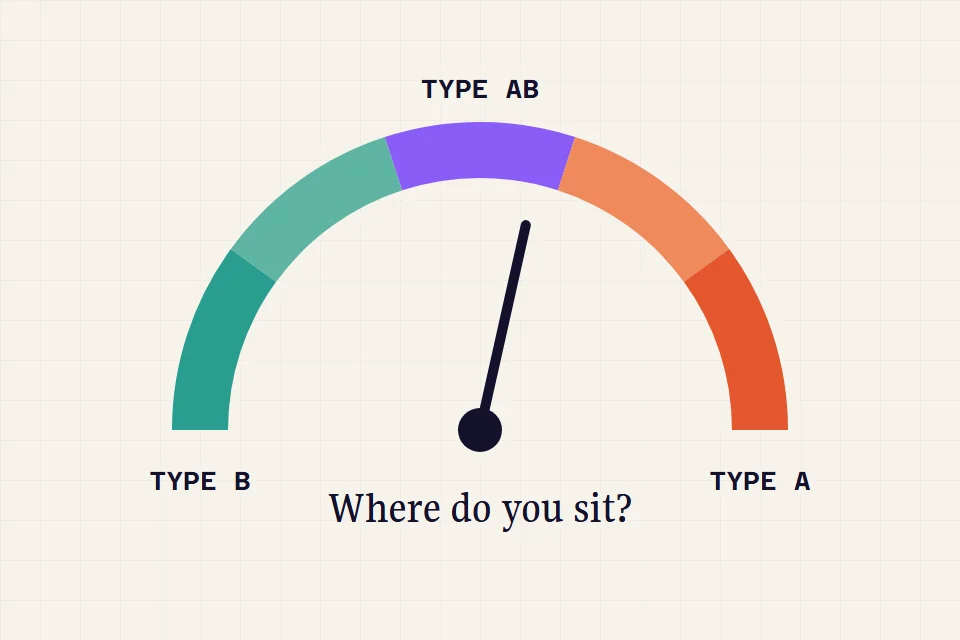
Type AB describes people who show a mix of Type A and Type B habits: driven when something matters, relaxed when it doesn’t. Friedman and Rosenman used the AB label for people who did not fit clearly at either end of their scale. It has nothing to do with blood type AB, and on our test it is a score from 41 to 60.
On this page
DefinitionWhat Is a Type AB Personality?
In shortType AB describes people who show a mix of Type A and Type B habits: driven when it counts, relaxed when it doesn’t. Friedman and Rosenman used the AB label for people who did not fit clearly at either end.
On our Type A test, Type AB is a score from 41 to 60, the middle of the scale where most people land. It is not a lack of personality. It means your pace depends on the situation, and your four part scores show which Type A habits you lean on.
Not blood typeType AB Personality Is Not About Blood Type
In shortMany search results for “type AB personality” are about blood type AB. The idea that blood type shapes personality comes from Japanese pop culture and has no scientific support. Type AB here means the middle of the Type A scale.
In betweenIs There a Personality Between Type A and Type B?
In shortYes: Type AB. Because Type A and Type B are two ends of one continuous scale, most people fall somewhere in between rather than at either end.
Early Type A research used a structured interview to sort people into grades, from fully developed Type A to fully developed Type B, with an even mix in the middle. Later questionnaires, such as the Jenkins Activity Survey, gave a score instead of a box (Jenkins, Zyzanski and Rosenman, 1971). A score shows what a label hides: how far you lean, and on which of the four parts.
CharacteristicsType AB Personality Characteristics
In shortTypical Type AB characteristics are switching gears with the situation, competing only when it matters, getting irritated sometimes but not often, and being able to rest once the work is done.
- Situational drive: you speed up for deadlines and slow down after them.
- Selective competitiveness: you want to win at work, not at board games, or the other way round.
- Moderate patience: short delays are fine; long ones start to bother you.
- Can switch off: holidays feel like holidays, at least after the first day.
- Lean depends on the part: your highest part score shows where Type A habits creep in.
TraitsType AB Traits: Strengths and Weaknesses
In shortType AB strengths are flexibility and balance. The weakness is that busy seasons can quietly turn you Type A.
Strengths
- You can switch between speed and patience as the situation needs.
- You care about results without needing to win everything.
- People find you both reliable and easy to be around.
- You can work to deadlines and still enjoy free time.
- You get on with both fast and slow-paced people.
Weaknesses to watch
- Busy seasons can tip you into Type A habits without noticing.
- You may adapt to other people’s pace and lose track of your own.
- Sitting in the middle can hide one high part, so read your part scores.
WorkType AB at Work: Careers That Fit
In shortAt work or study you can be the steady middle of a team: you speed up for deadlines, slow down for careful work and get on with colleagues on both ends.
You adapt well: fast when needed, careful when needed. You are often a good bridge between driven and relaxed colleagues.
Settings that tend to suit
- Roles that mix busy periods with steady ones
- Teams with a range of working styles
- Work with clear goals and some flexibility
- Jobs where people skills matter as much as speed
Career directions to explore
- Teaching, training and coaching
- Healthcare and support roles
- Design, research and product work
- Team-lead roles that balance people and targets
Colleagues likely see you as dependable and easy to work with. They may not see how much you adjust to fit in, so say what pace suits you. See careers by personality type or take the free Career Test for interest-based job matches.
Love and friendshipType AB in Relationships
In shortAt home you can enjoy slow time, and you also like a plan. People close to you probably find you easy to live with, as long as busy weeks don’t take over.
With a Type A person
A Type A person brings energy and momentum. You can keep up, and you can also remind them that not everything is urgent.
With a Type AB person
Two Type AB people usually share a flexible rhythm. The risk is that both drift into Type A mode in the same busy season, so plan rest together.
With a Type B person
A Type B person brings calm. You can enjoy their pace and still bring some structure when it’s needed.
StressType AB Under Pressure
In shortUnder pressure your Type A side tends to come out: faster, more focused and sometimes shorter with people. When the pressure lifts, you usually return to balance.
For a Type AB pattern, pressure usually comes in seasons. The key is noticing when a busy patch starts to become your new normal.
What tends to wind you up
- Several deadlines landing at once
- Other people’s urgency becoming yours
- Losing your usual routines for rest
- Feeling that you can’t say no
- Busy season. Work or life speeds up, and you speed up with it.
- Habits slip. Rest, exercise and slow time get pushed aside.
- Type A mode. You feel rushed and shorter with people than usual.
- Reset. When things calm down, you recover, if you give yourself the chance.
Ways to recover
- Spot the start of a busy season and plan your recovery in advance.
- Keep one non-negotiable rest habit, even in busy weeks.
- Check in with your part scores: the highest one is your usual pressure route.
- Say no to one thing each busy week.
More free tests
Keep reading
Share This Guide
Know someone who would find this useful? Send it to them in one tap.
QuestionsFAQ
What is a Type AB personality?
A mix of Type A and Type B habits: driven in some situations and relaxed in others. It is the middle of the Type A scale, where most people sit.
Is Type AB the same as blood type AB?
No. Blood type personality ideas have no scientific support. Type AB here means the balanced middle of the Type A to Type B scale.
Is Type AB rare?
No. Most people land in the middle of personality scales, so Type AB is the most common result on our test.
How do I know if I am Type AB?
A score from 41 to 60 on our free Type A personality test points to Type AB. Your four part scores show which side you lean toward.
Is Type AB better than Type A or Type B?
No band is better. Type AB is flexible; the habit worth watching on any part of the scale is long-term irritability.
Can I move between Type A and Type B?
Yes. Busy seasons often push people toward Type A habits, and deliberate rest and pacing pull them back toward the middle.
SourcesSources
- Friedman, M., & Rosenman, R. H. (1959). Association of specific overt behavior pattern with blood and cardiovascular findings. JAMA, 169(12), 1286–1296. doi:10.1001/jama.1959.03000290012005
- Ragland, D. R., & Brand, R. J. (1988). Type A behavior and mortality from coronary heart disease. New England Journal of Medicine, 318(2), 65–69. doi:10.1056/NEJM198801143180201
- Spence, J. T., Helmreich, R. L., & Pred, R. S. (1987). Impatience versus achievement strivings in the Type A pattern. Journal of Applied Psychology, 72(4), 522–528. doi:10.1037/0021-9010.72.4.522
- Jenkins, C. D., Zyzanski, S. J., & Rosenman, R. H. (1971). Progress toward validation of a computer-scored test for the Type A coronary-prone behavior pattern. Psychosomatic Medicine, 33(3), 193–202. doi:10.1097/00006842-197105000-00001