

The short answer
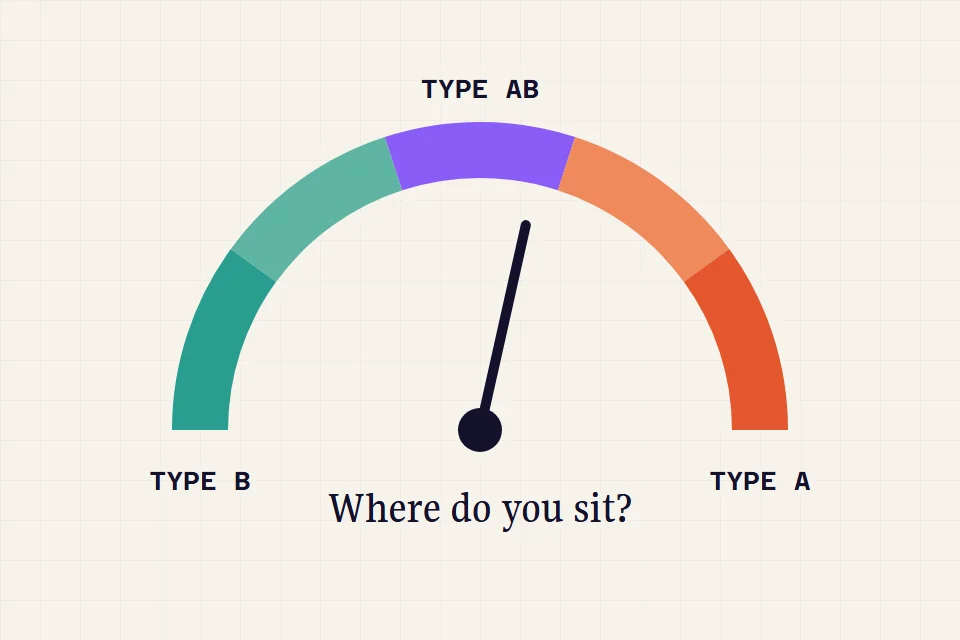
A Type B personality is the relaxed end of the Type A scale: patient, unhurried, not very competitive and slow to anger. Type B people feel less time pressure and less need to win, but that does not make them lazy or less capable. In the original research Type B simply meant the absence of the Type A pattern.
On this page
DefinitionWhat Is a Type B Personality?
In shortA Type B personality is the relaxed end of the Type A scale: patient, unhurried, not very competitive and slow to anger. In the original research, Type B simply meant the absence of the Type A pattern.
Type B is often described only by what it lacks, which makes it sound passive. In everyday life it looks like patience, steadiness and the ability to enjoy time without measuring it. Type B people can be just as capable as Type A people; they feel less time pressure and less need to win.
TraitsType B Personality Traits: Strengths and Weaknesses
In shortType B strengths are calm, patience and an easy way with people. The weaknesses are drifting deadlines, being read as not caring and letting chances pass.
Strengths
- You stay calm when others are stressed.
- You are patient with people and with delays.
- You can enjoy free time without guilt.
- You think things through instead of rushing.
- People find you relaxed and easy to talk to.
Weaknesses to watch
- Deadlines can sneak up on you without outside structure.
- Others may read your calm as not caring.
- You may let chances pass because you didn’t push for them.
CharacteristicsType B Personality Characteristics: 10 Signs
In shortTypical Type B characteristics are patience, a steady pace, little need to compete, slow-to-flare anger and the ability to rest without guilt.
- Patient: queues and delays rarely spoil your mood.
- Steady pace: you work at a speed you can keep up for months.
- Little need to win: you enjoy games and sport for their own sake.
- Slow to anger: irritation passes quickly and rarely turns into snapping.
- Rests easily: a free afternoon feels like a gift, not a waste.
- One thing at a time: you prefer to finish a task before starting the next.
- Flexible with time: plans can shift without stress.
- Reflective: you think before deciding and rarely rush.
- Easy company: people feel relaxed around you.
- Deadlines can drift: without a clear date, tasks may wait too long.
Examples: staying calm in a traffic jam, playing a game without keeping score, spending a holiday without checking work email. All of these can be learned, too; see how the two compare in Type A and Type B personality.
Not a disorderType B Personality vs Cluster B Personality Disorders
In shortType B personality has nothing to do with “Cluster B” personality disorders. Type B is an everyday, relaxed behaviour pattern. Cluster B is a group of four clinical diagnoses in the DSM-5: antisocial, borderline, histrionic and narcissistic personality disorder.
The two terms only share a letter, which is why searches for “type B personality disorder” mix them up. Cluster B diagnoses can only be made by a qualified professional after a full assessment. A personality test, ours included, cannot diagnose any disorder. For narcissism as an everyday trait, see narcissism: meaning, traits and scores.
MythIs a Type B Personality Lazy?
In shortNo. Type B describes how much time pressure and competitiveness you feel, not how hard you work or how able you are.
The Type A research measured hurry, drive, irritability and work involvement. A person can work steadily and well without feeling rushed or needing to beat others. Because the costly part of Type A is irritability rather than effort (Miller and colleagues, 1996), a calm, steady Type B pace is often the more sustainable one.
WorkType B at Work: Strengths and Best Careers
In shortAt work or study you are steady and thoughtful. You prefer depth to speed, and you tend to keep a team calm. Fast-moving, high-pressure settings may feel draining rather than exciting.
You work best with time to think, clear expectations and room to do things well. You are often the calm, careful voice in a team.
Settings that tend to suit
- Roles that reward care, depth and patience
- Teams with a steady pace
- Work with clear, early deadlines
- Jobs where listening matters
Career directions to explore
- Counselling, therapy and social work
- Research, writing and design
- Crafts, gardening and hands-on technical work
- Library, archive and quality roles
Colleagues likely see you as calm and easy to work with. In fast teams, a few may wish you showed more urgency, so share progress early. See careers by personality type or take the free Career Test for interest-based job matches.
Love and friendshipType B in Relationships
In shortAt home you value slow time, conversation and doing things for their own sake. People close to you probably find you a relaxing presence.
With a Type A person
A Type A person brings momentum, and you bring calm. Clashes come from pace. Agree on deadlines early, and remind them that slower isn’t careless.
With a Type AB person
A Type AB person can match your calm and bring some structure. They can be a good bridge to faster people.
With a Type B person
Two Type B people share an easy pace. The risk is that nobody pushes when something needs doing, so agree who owns which deadlines.
StressWhat Stresses a Type B Person
In shortUnder pressure you tend to stay calm, sometimes too calm for people who want to see urgency. If pressure lasts, you may withdraw rather than speed up.
For a Type B pattern, pressure rarely comes from impatience. It comes from other people’s urgency, and from deadlines left too late.
What tends to wind you up
- People who make everything urgent
- Surprise deadlines and last-minute changes
- Being judged for not looking busy
- Long stretches of fast, crowded work
- Outside pressure. Someone else’s urgency lands on you.
- Slow down. You hold your pace, and the gap grows.
- Friction. Others push harder, and you feel judged or pushed.
- Withdraw. You pull back, which can look like not caring.
Ways to recover
- Agree deadlines early, in writing, so urgency doesn’t surprise you.
- Show progress in small updates so others see your pace is working.
- Keep the calm habits that recharge you.
- Use a simple weekly plan as outside structure.
16 typesWhich Personality Types Are Type B?
In shortNo type is Type B by definition. Through the Big Five, people who prefer P and I tend to report a little less time urgency and drive, on average, but every type can be relaxed.
If your 16-type result has a P or an I, your Type B pace fits a common pattern. If it has a J, you may be calm and organised at the same time, which is a strong mix.
See your own letters with the free personality test. If you prefer quiet work, careers for introverts ranks 16 jobs by how much people-time they need.
More free tests
Keep reading
Share This Guide
Know someone who would find this useful? Send it to them in one tap.
QuestionsFAQ
What is a Type B personality?
The relaxed end of the Type A scale: patient, unhurried, not very competitive and slow to anger.
Is Type B better than Type A?
Neither is better. Type B brings calm and patience; Type A brings drive. The costly habit is irritability, which either type can have.
Is Type B the same as introverted?
No. Type B is about pace and pressure; introversion is about social energy. You can be an extraverted Type B or an introverted Type A.
Can Type B people be successful?
Yes. Success depends on skills, effort and fit, not on feeling rushed. Many Type B people do very well in roles that reward care and patience.
How do I know if I am Type B?
Take a test that scores the four parts of Type A. A score of 0 to 40 on our free Type A personality test points to Type B.
What jobs suit a Type B personality?
Roles that reward care, patience and listening often suit Type B people, such as counselling, research, design, crafts or quality work. Any job can work at a pace you can sustain.
Is Type B personality a personality disorder?
No. Type B is an everyday behaviour pattern. “Cluster B” is a separate group of four clinical personality disorders in the DSM-5; the two only share a letter.
Are Type B personalities happier?
There is no direct evidence that Type B people are happier overall. What research does show is that long-term hostility, a Type A habit, goes with more stress, so calm can protect well-being.
SourcesSources
- Friedman, M., & Rosenman, R. H. (1959). Association of specific overt behavior pattern with blood and cardiovascular findings. JAMA, 169(12), 1286–1296. doi:10.1001/jama.1959.03000290012005
- Ragland, D. R., & Brand, R. J. (1988). Type A behavior and mortality from coronary heart disease. New England Journal of Medicine, 318(2), 65–69. doi:10.1056/NEJM198801143180201
- Spence, J. T., Helmreich, R. L., & Pred, R. S. (1987). Impatience versus achievement strivings in the Type A pattern. Journal of Applied Psychology, 72(4), 522–528. doi:10.1037/0021-9010.72.4.522
- Miller, T. Q., Smith, T. W., Turner, C. W., Guijarro, M. L., & Hallet, A. J. (1996). A meta-analytic review of research on hostility and physical health. Psychological Bulletin, 119(2), 322–348. doi:10.1037/0033-2909.119.2.322
- Chida, Y., & Steptoe, A. (2009). The association of anger and hostility with future coronary heart disease. Journal of the American College of Cardiology, 53(11), 936–946. doi:10.1016/j.jacc.2008.11.044
- Petticrew, M. P., Lee, K., & McKee, M. (2012). Type A behavior pattern and coronary heart disease: Philip Morris’s “crown jewel”. American Journal of Public Health, 102(11), 2018–2025. doi:10.2105/AJPH.2012.300816
- Alarcon, G., Eschleman, K. J., & Bowling, N. A. (2009). Relationships between personality variables and burnout: A meta-analysis. Work & Stress, 23(3), 244–263. doi:10.1080/02678370903282600
- McCrae, R. R., & Costa, P. T. (1989). Reinterpreting the Myers-Briggs Type Indicator from the perspective of the five-factor model of personality. Journal of Personality, 57(1), 17–40.
- American Psychiatric Association. (2013). Diagnostic and statistical manual of mental disorders (5th ed.). Arlington, VA: American Psychiatric Publishing.