

PERSONALITY · 4 TEMPERAMENTS
Four Temperaments Test: what’s my temperament?
Our free temperament test shows whether you are mainly sanguine, choleric, melancholic or phlegmatic, plus your second temperament, on the two axes modern psychology uses to explain the old four types. 32 statements, about 5 minutes.
- 33 questions
- About 5 minutes
- Free summary
- Full report optional
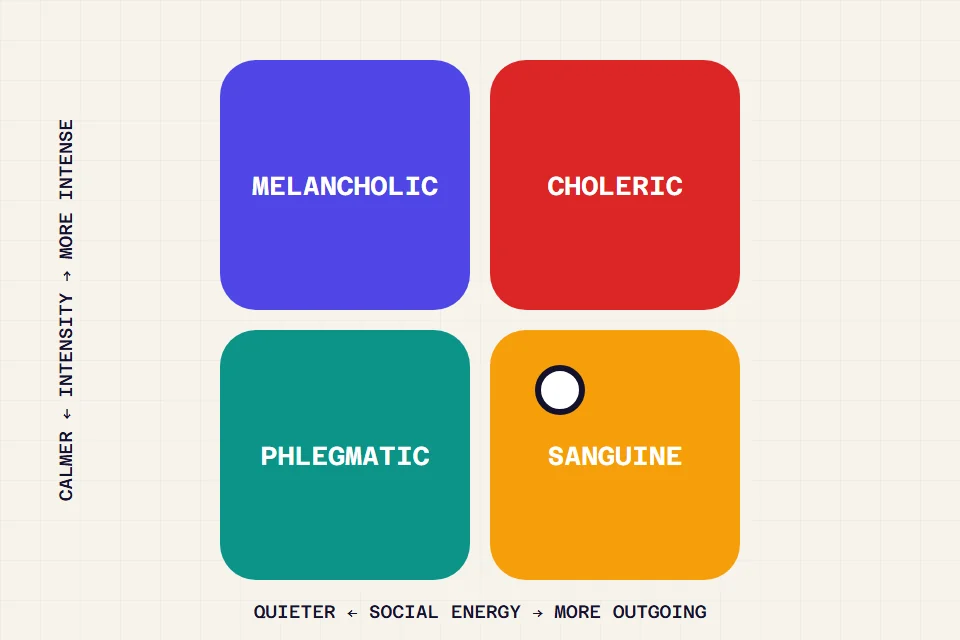
Sample result
Melancholic-Phlegmatic
Example only. Yours comes with your own map.
Built by the Insight Metrics team
- Written by Alden Cross, Research Writer
- Research check by Leon Falkner, Data & Research Analyst
- Reviewed by Aarav Vardhan, Editor-in-Chief
Insight Metrics is trusted by 2.4M+ people · As seen in Forbes and Wired
- Questions
- 32 statements + 1 quick pick
- Time
- About 5 min
- Cost
- Free to take · free summary
- Full report
- Optional
- Based on
- Eysenck’s two axes for the four temperaments
INTRODUCTION
The Four Temperaments Test is a free temperament test, also called a 4 temperament test or four temperament test, that shows which of the four classic temperaments fits you best: sanguine, choleric, melancholic or phlegmatic. You rate 32 short statements, 8 written for each temperament. Your answers place a dot on a two-axis map, social energy and emotional intensity, so you get your main temperament, your second one and an honest balanced result if you sit near the middle.
4
temperaments, each with its own fit score from 0 to 100
2
axes, social energy and emotional intensity, that place your dot on the map
32
statements written by our team, 8 for each temperament
I start conversations with strangers easily.
How much do you agree?
Pick an answer to start. Your choice is saved and the test continues from question 2.
HOW IT WORKS
How the temperament test works
- 01
Answer 33 short questions
Rate 32 statements like “My mood bounces back quickly after a disappointment” from Strongly disagree to Strongly agree. Answer for how you usually are. Then, if you like, pick the portrait that sounds most like you.
- 02
See your free summary
A short form asks for your contact details, then your result opens: your temperament map, your main and second temperament, all four fit scores, three strengths and how your own view compares.
- 03
Go deeper if you want
The full report is optional. It covers your temperament with people, at work and under stress, both axes at your level, you with each temperament, careers and a 4-week plan, on the page and as a PDF.
Find your temperament blend
Take the four temperaments test free: 33 short questions, about 5 minutes, with your map, your blend and all four scores in a free summary.
Free to take · Free summary · Full report optional
THE 4 TEMPERAMENTS
The four temperaments on the map
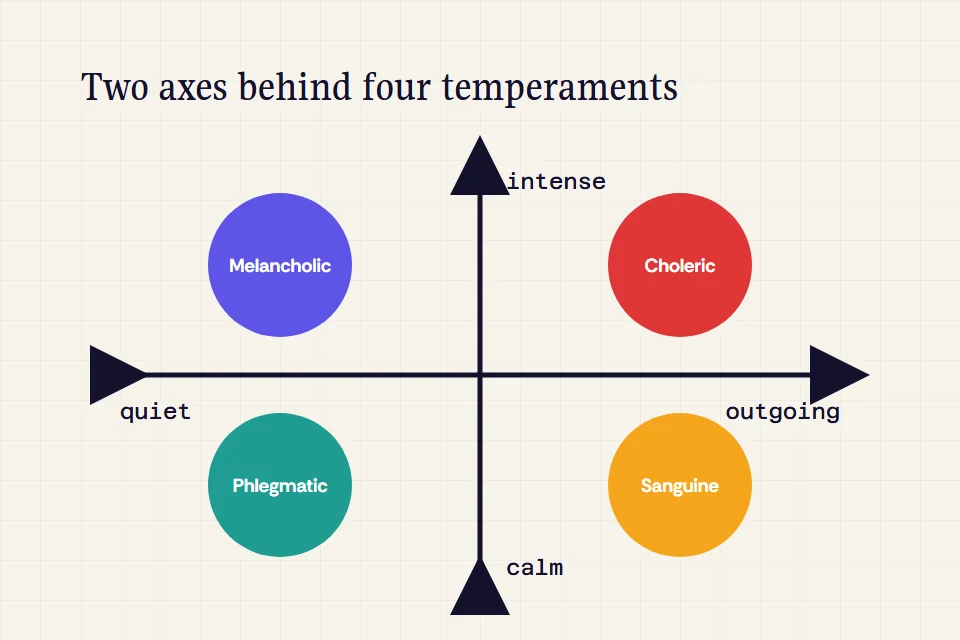
Each temperament is an area on one map, not a box. Outgoing or quiet is one axis; calm or intense is the other. Most people have a main temperament and a clear second one. On this temperament test, choleric and sanguine results are the outgoing ones.
Sanguine
Outgoing and calm. Warm, upbeat, sociable and spontaneous, quick to bounce back from setbacks. Can find routine and follow-through hard.
Read the sanguine temperament guideCholeric
Outgoing and intense. Driven, decisive, direct and quick to act, a natural leader in a crisis. Can be impatient and quick to anger.
Read the choleric temperament guideMelancholic
Quiet and intense. Thoughtful, careful, loyal and deep-feeling, with high standards. Can worry and be hard on themselves. Not the same as depression.
Read the melancholic temperament guidePhlegmatic
Quiet and calm. Patient, steady, peaceful and easy to be around, calm when others panic. Can avoid conflict and change.
Read the phlegmatic temperament guideFeatures
What a result looks like
A made-up example. This person’s dot sits in the melancholic area, close to the line with phlegmatic, so the result is a melancholic-phlegmatic blend: thoughtful and careful, with a calmer side than most melancholics.
WHAT YOU GET
Free summary, optional full report
Free summary
- Your temperament map with your dot
- Your main and second temperament
- Fit scores for all four temperaments
- Three strengths of your temperament
- Your own view compared with your answers
Full report
- Your temperament with people, at work and under stress
- Both axes explained at your level
- You with each of the 4 temperaments
- Work style and career directions
- What drains and restores you
- A 4-week plan, plus a PDF copy
The test and summary are free. The full report is optional, with a full refund if you ask within 3 days.
Why this temperament test is different
Most temperament quizzes give you one word. Ours places you on the two axes psychologists use, shows all four fit scores and gives a straight answer when you sit in the middle.
- Main and second temperament
- All four scores free
- Honest balanced results
- History without myths
- Links to your 16 type
- Work and relationships
- For self-reflection
QUICK ANSWERS
Four temperaments test: quick answers
Short, direct answers to the questions people ask most, written and checked by our editorial team.
What are the four temperaments?
The four temperaments are sanguine, choleric, melancholic and phlegmatic. Sanguine people are outgoing and calm, choleric people outgoing and intense, melancholic people quiet and intense, and phlegmatic people quiet and calm. The names come from ancient Greek medicine, and modern psychology explains them with two traits: extraversion and emotional reactivity.
What is a temperament test?
A temperament test is a short questionnaire about your natural way of reacting: how outgoing you are and how strongly you feel things. Ours uses 32 statements, 8 for each of the four classic temperaments, and places your answers on a two-axis map. It shows your main temperament, your second one and a fit score for all four.
How do I know my temperament?
Ask two questions. First, do people and activity charge you up or wear you out? That is your social energy. Second, do your feelings run strong and fast or calm and steady? That is your emotional intensity. Outgoing and calm is sanguine, outgoing and intense choleric, quiet and intense melancholic, quiet and calm phlegmatic.
Can you have two temperaments?
Yes. Most people have a main temperament and a clear second one, often called a blend, such as sanguine-choleric or melancholic-phlegmatic. The idea of primary and secondary temperaments goes back to the 17th century. On our test, your second temperament is the neighbouring area on the map that your dot sits closest to.
Where do the four temperaments come from?
They come from humoral medicine. Hippocrates linked health to four body fluids, and Galen later described temperaments as mixtures of them. The humours are not real, and modern medicine dropped the theory long ago. The personality descriptions survived, and in the 20th century Hans Eysenck showed they fit two measurable traits.
Are the four temperaments scientific?
Partly. The humour theory behind them is wrong, but the four portraits line up well with two of the best-studied traits in psychology, extraversion and neuroticism. Wundt and Eysenck both placed the four types on those axes. A temperament test is useful for self-reflection, while full trait tests such as the Big Five measure personality in more detail.
What is the rarest temperament?
There are no reliable figures, because no large, representative study has counted the four temperaments. Online claims that one temperament is rarest are not based on research. On a two-axis map, every quadrant is common, and many people sit near a line or near the middle, which is why our results show a blend rather than a single label.
Is melancholic temperament the same as depression?
No. Melancholic as a temperament describes a thoughtful, careful, deep-feeling person who may worry and set high standards. Depression is a health condition with its own symptoms, and melancholic depression is a clinical term for one form of it. A temperament test cannot tell you anything about depression; a doctor can.
How are temperaments linked to the 16 personality types?
Through one axis. Social energy in the temperament model is the same idea as the E–I letter: sanguine and choleric lean extraverted, melancholic and phlegmatic lean introverted. The 16-type model has no letter for emotional intensity. Charts claiming that each temperament equals specific types, such as sanguine equals ESFP, are folk mappings without research.
Is this the same as the Keirsey temperaments?
No. Keirsey’s four temperaments group the 16 types by their letters: SP, SJ, NF and NT. That is a different model, built from how people communicate and act, not from extraversion and emotional intensity. Our test measures the classic Hippocratic four. Some websites mix the two up, which is why their temperament charts disagree.
How long does the temperament test take?
About 5 minutes. There are 32 statements, 8 for each temperament, answered on a five-point scale from Strongly disagree to Strongly agree, plus one optional question where you pick the portrait that sounds most like you. Your free summary, with your map and all four scores, opens right after a short form.
Can your temperament change?
Your basic temperament is fairly stable, but it is not fixed. Research on the related traits shows that people tend to become calmer and more agreeable with age, and that life experiences shift traits a little. You can also learn habits from the other temperaments, like a choleric learning patience or a phlegmatic learning to speak up.
What is the four temperaments test?
In short
The four temperaments test is a short self-report questionnaire that shows which classic temperament fits you best. Ours scores all four temperaments, then turns those scores into two axes, social energy and emotional intensity, so you see where you sit on one map.
| Temperament | Social energy | Emotional intensity | In a few words |
|---|---|---|---|
| Sanguine | Higher | Lower | Warm, upbeat, spontaneous |
| Choleric | Higher | Higher | Driven, decisive, direct |
| Melancholic | Lower | Higher | Thoughtful, careful, deep-feeling |
| Phlegmatic | Lower | Lower | Calm, steady, patient |
For the full portrait of each temperament, with strengths, relationships and work, read the four temperaments explained.
How is the temperament test scored?
In short
Each temperament score is your average on its 8 statements, on a 0–100 scale. Social energy is the outgoing temperaments minus the quieter ones; emotional intensity is the intense temperaments minus the calm ones. Your main temperament is the area your dot lands in.
Your second temperament is the neighbouring area across the nearer line, because that is the line you are most likely to cross on a different day. Two of each temperament’s 8 statements are worded the other way round, like “Criticism slides off me easily”, so the test can’t be answered on autopilot. If your dot is within 7 points of the middle, or most of your answers were Neutral, your result says balanced instead of forcing a label.
This is a new test, so we don’t compare you with other people and your scores are not percentiles. See how our tests work for our general approach.
Where do the four temperaments come from?
In short
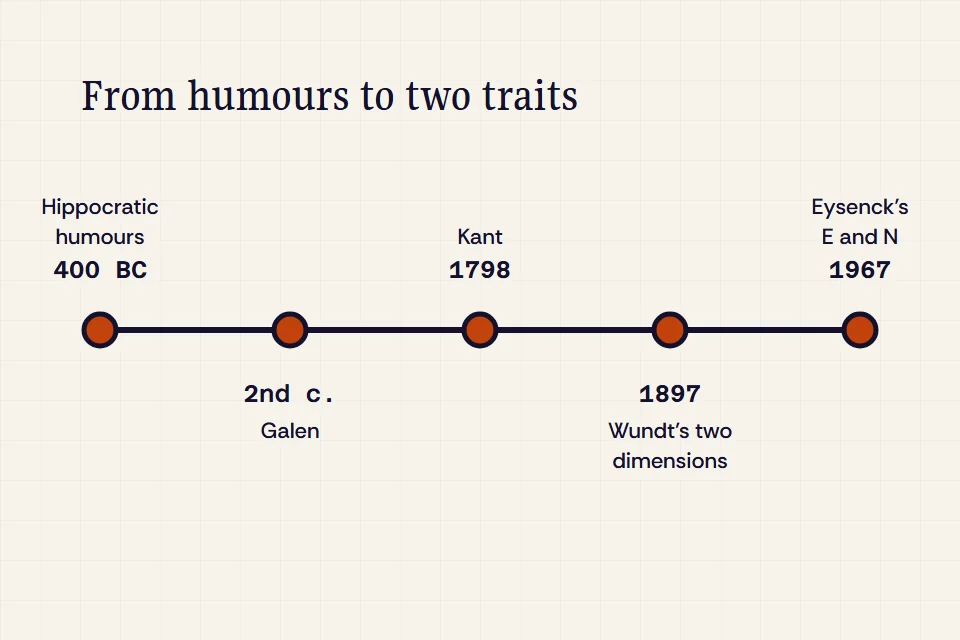
The four temperaments began as medicine, not psychology. Hippocrates tied health to four body fluids, and Galen described temperaments as mixtures of them. The humours turned out to be wrong, but the personality portraits that grew from them in the 18th and 19th centuries are still recognisable.
- Around 400 BC: Hippocratic writers describe four humours: blood, yellow bile, black bile and phlegm.
- 2nd century AD: Galen writes about temperaments as mixtures of hot, cold, wet and dry. Historians note he said little about character (Stelmack and Stalikas, 1991).
- 1798: Immanuel Kant describes the four as temperaments of feeling and of activity.
- 1897: Wilhelm Wundt explains them with two dimensions: how strong and how changeable emotions are.
- 1960s–1980s: Hans Eysenck shows the four sit in the quadrants of extraversion and neuroticism, two traits that can be measured and studied.
That last step is why our test uses two axes. It keeps what holds up and drops what does not.
Eysenck’s two axes: social energy and emotional intensity
In short
In Eysenck’s model, sanguine is stable and extraverted, choleric unstable and extraverted, melancholic unstable and introverted, and phlegmatic stable and introverted. We call the axes social energy and emotional intensity, because “unstable” sounds harsher than the trait it describes.
Both axes are continuous, like height. Most people are not at an extreme, and people near a line can land on the other side on a retest, which is why we show your exact scores and your second temperament, not just one word. Emotional intensity is the trait psychologists call neuroticism; if yours is high, high neuroticism explained covers what the research says. For extraversion on its own, the free introvert or extrovert test measures it in more detail.
The four temperaments and the 16 personality types
In short
Social energy matches the E–I letter of the 16 types: sanguine and choleric lean E, melancholic and phlegmatic lean I. Emotional intensity has no letter in the 16-type model; the closest idea is the -A or -T ending. Charts that give each temperament specific types have no research behind them.
So a sanguine can be an ESFP or an ENTP, and a melancholic can be an INFJ or an ISTJ. To find your four letters, take the free personality test, then read your type on the 16 personality types. Keirsey’s SP, SJ, NF and NT groups are a different four-way model built from the type letters; we explain them on the group pages, starting with the NF types.
What the four temperaments can and can’t tell you
In short
The four temperaments are a good mirror for two big traits, but they leave out others, such as conscientiousness, openness and agreeableness. Short descriptions also feel accurate to almost anyone, a well-known effect psychologists call the Barnum effect (Forer, 1949).
To guard against that, our portraits name real trade-offs, not just compliments, and the full report ties every section to your actual scores. For a broader picture of your personality, the Big Five personality test measures five traits and 30 facets.
Temperaments at work and in relationships
In short
Temperament shapes how you like to work and connect: sanguines enjoy people and variety, cholerics responsibility and pace, melancholics depth and quality, and phlegmatics calm and routine. No temperament is better; opposite temperaments often balance each other well in teams and couples.
The full report covers you with each temperament and career directions. For job matches based on your interests, take the free Career Test. For how you bond in close relationships, try the attachment style quiz.
Read the full guide to your temperament
In short
Each temperament has its own guide with strengths, weaknesses, relationships, work and stress. Start with your main temperament, then read your second one.
- Sanguine temperament: traits, strengths and weaknesses
- Choleric temperament: traits, strengths and weaknesses
- Melancholic temperament: traits, strengths and weaknesses
- Phlegmatic temperament: traits, strengths and weaknesses
All four side by side: the four temperaments explained. Every model on our site is in the Personality Library.
FAQ
Four Temperaments Test FAQ
Is this four temperaments test free?
Yes. It is free to take, with a free summary that shows your map, your main and second temperament, all four fit scores and three strengths. A full report is optional.
How many questions are in the test?
33: 32 statements, 8 for each temperament, plus one optional question where you pick the portrait that sounds like you. You can test temperament in about 5 minutes.
Is this a choleric temperament test too?
Yes. Every result scores all four temperaments, so it works as a choleric temperament test as well as a sanguine, melancholic or phlegmatic one. Look at your choleric fit score and where your dot sits on the map.
What does my second temperament mean?
It is the neighbouring area on the map that your dot is closest to. It usually explains the side of you that your main temperament misses, like a choleric with a melancholic eye for detail.
What does a balanced result mean?
Your dot sits within 7 points of the middle of the map, so no temperament stands out. You probably show all four in different settings. The four fit scores still show your leanings.
Is one temperament better than the others?
No. Each has strengths and costs. Teams and couples often work best with a mix of temperaments.
Is this test based on the humours?
No. The humours are not real. We use the two traits that modern psychology found behind the four portraits: social energy (extraversion) and emotional intensity (neuroticism).
Is this a Christian temperament test?
No. Some popular books on the temperaments come from Christian writers, and those books are part of why the model is well known today. Our test is not linked to any faith or publisher.
Can I take this test for my child?
No. This test is for adults. Child temperament is a separate area of research with its own questionnaires, filled in by parents.
Why is my result different from another temperament test?
Many quizzes ask you to pick one word from four, which forces a label. Ours scores each temperament separately and places you on two axes, so blends and balanced results show up.
Can my temperament change?
Your basic temperament is fairly stable, but traits shift a little with age and experience, and you can learn habits from the other three. Retaking the test after a few months shows what has moved.
Is my data private?
Your answers are used to score your result. We don’t sell your details. See our Privacy Policy for how long results are kept and how to ask for them to be deleted.
Who wrote this test?
The Insight Metrics editorial team: written by Alden Cross, research-checked by Leon Falkner and reviewed by Aarav Vardhan. The statements are our own wording.
START YOUR ASSESSMENT
Find out your temperament
A free temperament quiz: 33 questions, about 5 minutes. Free to take, free summary, full report only if you want it.